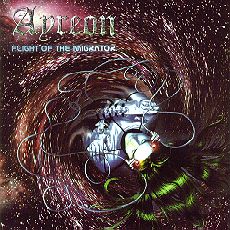
Image © 2001\r\n\r\nInsideOut Music
The Story
Flight of the Migrator follows a different course.
It takes us back to the beginning of time, just before the Big Bang,
from which the universe originated. It was a time of utter chaos.
During that Big Bang the first sould comes into being, the Universal
Migrator. It divides into a great many parts, which all start out on
a journey to a planet where they can settle. They bring life to the
various planets and initiate various forms of civilization. With the
aid of the Dream Sequencer the colonists on Mars follows one of those
souls on its long journey to earth. He passes astronomical phhenomena
such as quasars, pulsars, super novas, black holes and wormholes.
Meanwhile the Dream Sequencer does everything in its power to wake
the colonist from his deep hypnosis.
Even though the principle and main figures were developed
by Arjen, his descriptions of astronomical phenomena are uncannily
accurate. Lucassen buried himself in the studies of Stephen Hawking,
a scientist who has studied the source of the human race for many
years, and provides insight within the lyrics to Universal Migrator.
More Arjen Anthony Lucassen
Live On Earth
Space Metal
Ayreonauts Only
Flight Of The Migrator
The Dream Sequencer
Fate Of A Dreamer
|
|
Flight of the Migrator opens with an exhiliratinginstrumental romp "Chaos." Metal-edged electric guitar, shimmering Hammond organ and vast progressive-style synthesizer riffs illustrate the virtuosity of Arjen Anthony Lucassen and Erik Norlander. Crisp percussion—and a dramatic solo—by Ed Warby underscores the arrangement. Jubilant ELP-style keyboards, characteristic of ErikNorlander's work, blend with heavy guitar in the first vocal number—underscored by male choir—entitled "Dawn of a Million Souls" with the lead sung by Sir Russel Allen. Symphonically orchestral progressive keyboard work during one bridge is as stunning as the shattering guitar solos in others. Damian Wilson's backing vocalsprovide additional texture to the track. One of the standout tracks from the album is "Journeyon the Waves of Time" sung by Ralf Scheepers. A hard driving rock tune, it balances heavy metal sounds with lush Hammond organ riffs and a catchy melody, supported by the lead vocal, keyboards and choir textures. Arjen's unique variation of the Beatlesque style re-emerges in "To the Quasar" sung by Andi Deris. Delicate synthesizer and guitar perfectly compliment the processed vocal part. Full of special effects, the symphonic metal-edged keyboard and guitar instrumental passages are especially notable. The three-movement "Into The Black Hole" blendsmetal guitar sounds with progressive keyboard work and the soaringvocal work of Iron Maiden's Bruce Dickson. Lana Lane's backingharmony vocals compliment perfectly as does the keyboard rompnear the track's conclusion. With Rhapsody's Fabio Kotipeltodramatic lead vocal, "Through The Wormhole," is a fast paced, percussive heavy-metal rocker. Lana Lane's harmony backing vocal is subdued beneath the instrumental arrangement. A vast guitar solo and romping keyboard solo, both by Gary Wehrkamp, are quite noteworthy additions to the piece. "Out of the White Hole," sung by Stratovariousvocalist Timo Kotipelto is performed in a style similar to "IntoThe Black Hole." Lush majestic symphonic keyboards are contrasted by heavy metal-edged guitars. Keyboard solos are reminscent ofELP's Tarkus. Hard driving guitars and vocal harmoniesby Robert Soeterboek dominate the arrangements of "To The SolarSystem" until lush Hammond organ and further keyboards join thearrangement. Heavily processed vocals in Battlestar GallacticaSylon-style conlude the track in "System Alert." The album concludes with "The New Migrator," astriking blend of orchestrally symphonic progressive instrumentalswith heavy metal, complete with heavily percussive guitar work anddouble bass drum. Ian Parry's lead vocal and self-backing harmonyparts are dramatically performed. Lana Lane also contributesbacking vocal work to the final track. Lucassen's guitar solo isperfectly complimented by Keiko Kumagai's synthesizer and Hammondorgan solos. Much different than the first part of the set, Flightof the Migrator is equally enjoyable, especially for lovers ofmetal-edged song-based progressive rock. Certainly not a femalevocals album by any means, it remains full of well-sung parts by a range of extremely talented musicians. A perfect compliment to the first part of the set, this album is worth a trans-Atlanticjourney and is also a must listen! range of extremely talented musicians. A perfect compliment to the first part of the set, this album is worth a trans-Atlanticjourney and is also a must listen!
|

